

Fire Ant Control in North Richland Hills, TX
Fire ants thrive in North Texas springs and summers, and North Richland Hills residents face active pressure from these aggressive colonies year-round due to the region's climate. Dill Pest Control connects property owners throughout North Richland Hills—including neighborhoods like Smithfield and Diamond Loch—with local pest control providers who specialize in fire ant removal and prevention. Getting ahead of an infestation protects your family, pets, and property from painful stings and costly mound damage.
When are fire ants active in North Richland Hills, TX?
Two things decide when you see a pest: what the species does, and what the weather here actually does. Below is the published guidance on the first, set against this city's own measured climate.
“Foraging activity slows when soil temperature is lower than 65 to 70 °F or higher than 90 °F.” UGA Extension
“Mating flights are most common in spring and fall.” UGA Extension
Because that is a temperature rule rather than a date, it can be read directly against the local figures below — the months that cross 90 °F are the months when foraging slows at the top end.
North Richland Hills averages 28.5 days at or above 90 °F in July — the stretch when UGA's upper limit is being crossed — and 107.6 such days across the year.Source: NOAA 1991-2020 Climate Normals, DALLAS LOVE FLD, TX US station (7.4 mi from North Richland Hills)

Fire Ant Control North Richland Hills Property Owners Need
North Richland Hills homeowners face a persistent fire ant challenge that intensifies during the warmer months of spring and summer. Fire ants thrive in the North Texas climate, establishing colonies in yards, around foundations, and in landscaped areas where they pose a genuine threat to families and pets. The problem is compounded by year-round activity driven by the region's seasonal patterns—even as temperatures cool, these invasive insects remain active in protected spots, making proactive fire ant control essential for year-round protection. Property owners in neighborhoods like Smithfield and Diamond Loch report ongoing issues, underscoring how widespread the concern has become across North Richland Hills.
Dill Pest Control connects North Richland Hills property owners with independent local providers who understand the specific dynamics of fire ant infestations in this area. These professionals take a thorough, methodical approach to fire ant control—identifying active colonies, treating affected zones strategically, and establishing follow-up monitoring to ensure populations don't rebound. Rather than a one-time spray, comprehensive fire ant management in North Richland Hills requires persistence and local expertise. When you reach out through Dill Pest Control, you'll be matched with a nearby provider ready to assess your property and develop a fire ant control plan tailored to your situation, giving you confidence in lasting results.
Why North Richland Hills Homeowners Trust Dill for Fire Ant Control
Fast Local Fire Ant Response
Fire ant colonies grow rapidly in North Texas heat. Dill connects you with independent local providers ready to address infestations quickly, minimizing the risk of spreading mounds across your property.
Clear Fire Ant Treatment Plans
Effective fire ant control requires a tailored approach. Dill's network of independent providers explains their fire ant treatment strategy upfront, so you understand what's happening on your property and what to expect.
Thorough Fire Ant Elimination
Incomplete fire ant treatment leaves colonies to reestablish. Dill connects you with local independent providers who apply comprehensive fire ant control methods designed to address both visible and hidden mounds.
Fire Ant Pressure Year-Round in North Richland Hills
Fire ants remain a persistent concern through North Texas seasons, with activity surging during warm months. Early intervention through Dill's referral network helps property owners stay ahead of infestations before they expand.
How Our Fire Ant Treatment Works
Schedule Your Fire Ant Control Visit
Contact Dill to describe your fire ant problem, and we'll connect you with a local pest control provider in North Richland Hills who handles fire ant infestations. Your provider will confirm availability and arrange a time that works for your schedule.
Receive Fire Ant Assessment & Treatment Plan
The provider inspects your property to identify fire ant mounds, nesting patterns, and affected areas, then recommends a targeted fire ant control approach tailored to your North Richland Hills property. Spring and summer months typically bring the highest fire ant activity in North Texas, so prompt action helps prevent colony expansion.
Complete Fire Ant Treatment & Follow-Up
Your provider applies fire ant control measures across identified colonies and problem zones. Follow-up visits may be scheduled to monitor results and address any remaining fire ant activity, ensuring your property stays protected.
Ready to get rid of fire ants in North Richland Hills? A local provider can get started fast.
Call (817) 993-4445Fire Ant Control Across North Richland Hills
Fire ants thrive in North Richland Hills year-round, with populations surging most aggressively during spring and summer months when warm temperatures accelerate colony growth and foraging activity. The region's combination of open yards, landscaped properties, and soil conditions creates ideal habitat for these aggressive insects. Whether you live in established neighborhoods like Smithfield with mature trees and older construction, or in newer subdivisions such as Diamond Loch and Iron Horse with developing landscape features, fire ant colonies can establish themselves in virtually any yard—under mulch, near foundations, within turf, and along fence lines. The seasonal intensity means spring inspections and early intervention are critical; waiting until summer heat arrives often means confronting larger, more defensive colonies.
Beyond seasonal pressure, North Richland Hills properties face persistent fire ant activity because these insects adapt quickly to residential environments. Local providers connected through Dill can help identify active mounds, assess property layout for high-risk zones, and recommend control strategies suited to your specific yard conditions. Early detection and prompt action reduce the risk of painful stings and protect family members and pets during peak outdoor season.
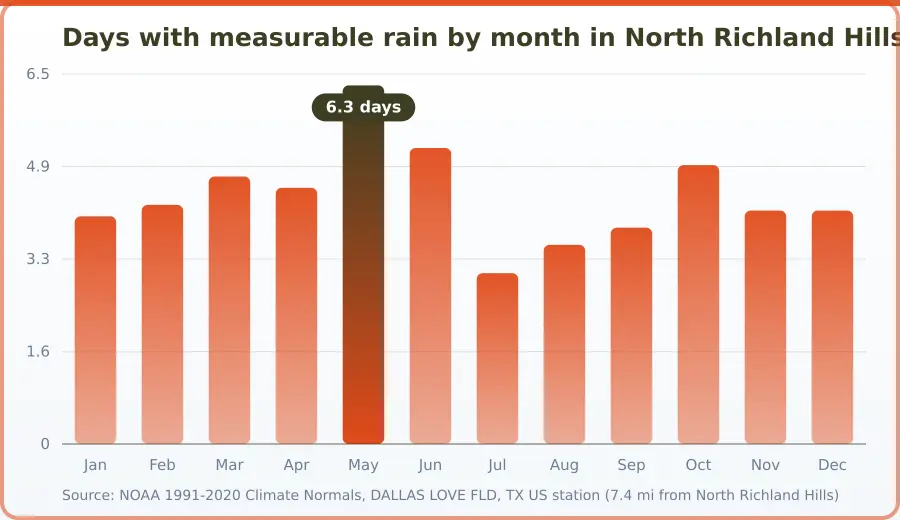
| Period | Days with measurable rain by month (days) |
|---|---|
| Jan | 4 |
| Feb | 4.2 |
| Mar | 4.7 |
| Apr | 4.5 |
| May | 6.3 |
| Jun | 5.2 |
| Jul | 3 |
| Aug | 3.5 |
| Sep | 3.8 |
| Oct | 4.9 |
| Nov | 4.1 |
| Dec | 4.1 |
Source: NOAA 1991-2020 Climate Normals, DALLAS LOVE FLD, TX US station (7.4 mi from North Richland Hills). Retrieved October 5, 2026.
Fire Ant Control Across North Richland Hills Seasons
Spring: Colony Awakening
As temperatures warm after March 2, fire ant colonies emerge from dormancy and begin rapid expansion across yards and landscaping. Spring's increased rainfall—averaging 4.7 rain days in March—creates ideal conditions for mound construction and foraging. Dill connects North Richland Hills homeowners with local providers who identify and treat active colonies before peak breeding season arrives.
Summer: Peak Activity
Fire ants thrive during North Richland Hills summers, with over 28 days annually reaching 90°F or higher, fueling aggressive colony growth and multiple reproductive cycles. Increased ground moisture and heat drive mounds deeper and workers farther from nests. Dill's referral network links property owners to local providers equipped to manage widespread summer infestations before they establish permanent territory.
Fall: Consolidation Phase
Fire ant colonies strengthen their defenses as temperatures cool toward November 29's first frost, consolidating resources and expanding underground networks. Fall rainfall supports foraging while colonies prepare for winter survival. Dill helps North Richland Hills residents connect with local providers to treat established colonies during this critical window before cold weather limits treatment options.
Winter: Dormancy and Depth
Fire ants don't disappear in winter—they retreat deeper into soil where freezing nights average 6.5 days in December. Cold slows activity but doesn't eliminate colonies, while occasional warm spells trigger temporary foraging surges. Dill assists homeowners in areas like Smithfield and Iron Horse in reaching local providers who apply winter strategies targeting deep mound structures before spring emergence.
Fire Ant Control FAQs — North Richland Hills, TX
Fire ant control typically targets active mounds and the colonies beneath them using methods suited to your property's layout and infestation severity. The independent local provider you're connected with will assess your yard, identify mound locations, and apply appropriate treatments to eliminate colonies. Expect a customized approach based on your specific situation rather than one-size-fits-all service.
Dill Pest Control connects you with independent local providers in North Richland Hills who can often respond to fire ant infestations promptly. Response times depend on current demand and the provider's schedule. Contact a provider directly to discuss your infestation and get a timeline for inspection and treatment scheduling.
Fire ant control costs typically depend on your property size, the number and density of active mounds, treatment method chosen, and whether follow-up visits are needed. Each independent provider sets their own pricing based on these variables. Request quotes from providers in North Richland Hills to compare costs for your specific yard.
Before treatment, the provider may ask you to keep pets and children away from treated areas and to note any recent yard activity near mounds. Clear access to affected zones if possible. Your provider will give you specific pre-treatment instructions and explain what to avoid during and after service to ensure safety and effectiveness.
After fire ant control, monitor your yard regularly for new mound activity, especially in spring and summer when colonies are most active in North Texas. Reduce standing water, maintain yard drainage, and avoid creating ideal nesting conditions with mulch buildup. Consistent yard inspection helps catch early signs so you can contact a provider before reinfestation spreads.
Fire ant activity peaks during North Texas spring and summer months when colonies expand and become more aggressive. However, mounds can remain active year-round in this region. If you notice fire ant mounds in fall or winter, prompt control is still important to prevent spring population explosions across your property.
Homeowner Safety Toolkit
Verify Your North Richland Hills, TX Pest Control Company
Before you hire anyone, use these independent national resources to confirm credentials, standards, and track record.
EPA
The federal government's own guide to choosing a pest control method and using pesticides safely around your home and family.
Pesticide Safety GuideNPMA
QualityPro is the pest control industry's own accreditation program, endorsed by the National Pest Management Association. Find and verify a company's accreditation before you hire.
Find a Certified ProAAPCO
The national association of state pesticide regulators. Use it to find your own state's licensing agency and confirm a company's applicator license is current.
Find Your State AgencyRelated Services
Dealing with fire ants in North Richland Hills? Get fast, targeted treatment from a local provider.
Call (817) 993-4445Areas We Serve in North Richland Hills, Texas
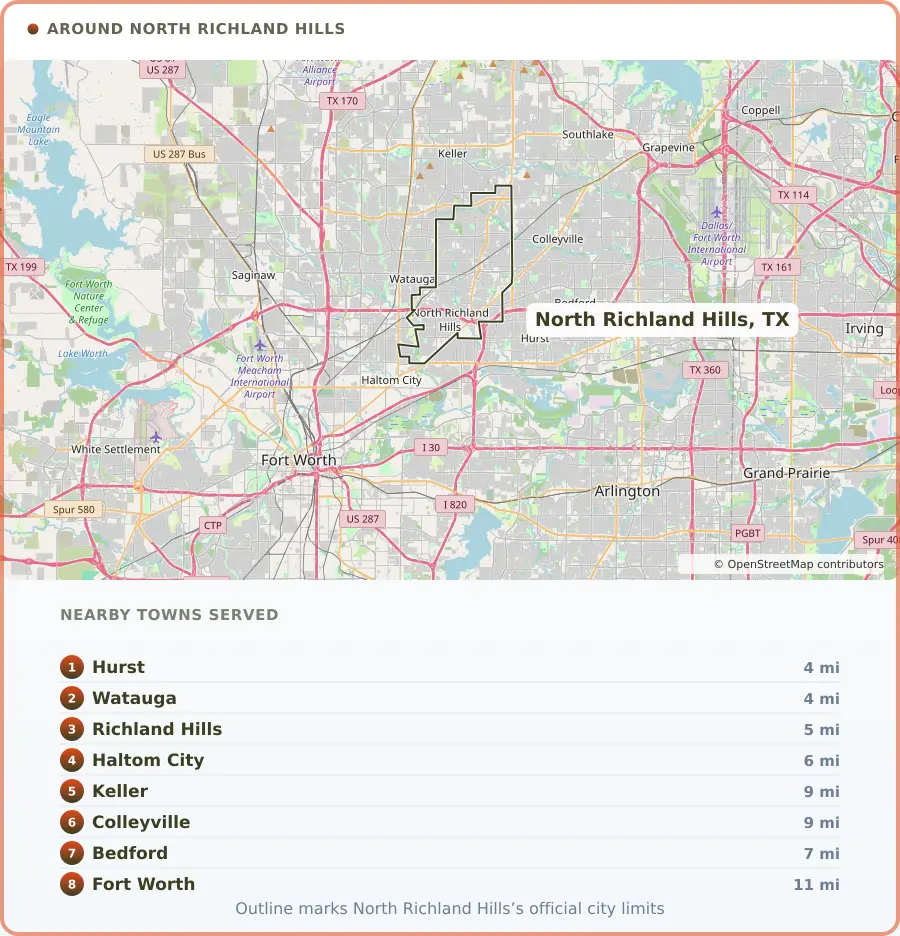
Coverage centres on North Richland Hills, TX and reaches 8 surrounding communities. Response time is what matters most in the hours after a problem is found, so knowing the ground is part of the job.
North Richland Hills, TX Information
Tucked between Fort Worth and the heart of the Dallas-Fort Worth metroplex, North Richland Hills, TX, is home to roughly 71,000 residents who enjoy settled, tree-lined neighborhoods with big-city access close by. Established pockets like Smithfield and Diamond Loch give the city a lived-in, familiar character, while the retail corridor along Boulevard 26 keeps daily errands within easy reach.
The local economy leans on healthcare, education, and retail trade, with North Hills Hospital, Birdville ISD, and national chains such as Walmart, Target, and Home Depot anchoring steady employment. Many residents commute into the broader DFW job market, but the city holds its own too, drawing families to NRH2O Family Water Park each summer and supporting a growing mix of logistics, manufacturing, and professional services.
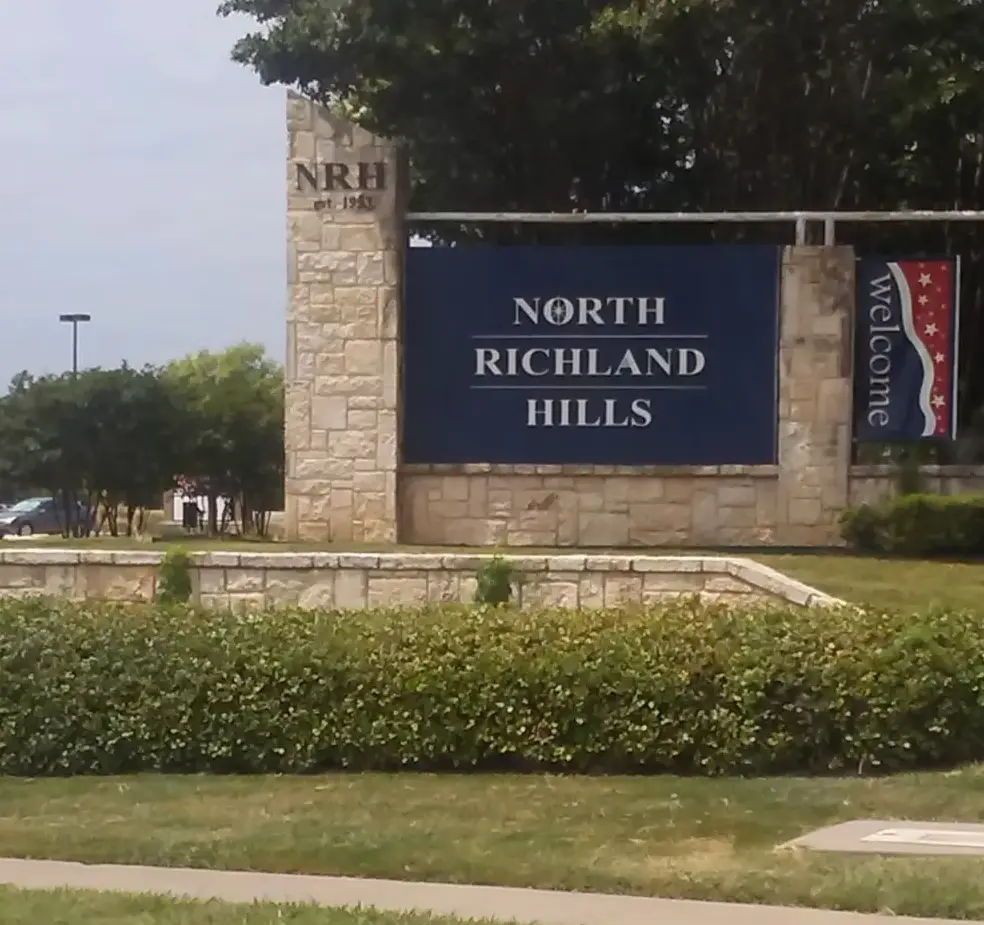
Photo: Smarty9108, CC BY-SA 4.0